
GAO: Five Years After Bonhomme Richard, Navy Still Lagging on Fire Safety
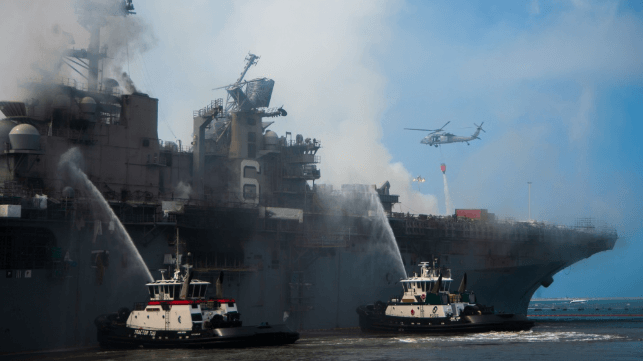
Five years after the destruction of the amphib USS Bonhomme Richard in San Diego, the Navy is still falling short on fire prevention during in-port ship repair periods, according to the Government Accountability Office (GAO). In a new report, the watchdog agency says that staff shortages have left some commands too overtasked to deal properly with fire prevention, and that hiring limits imposed by the Trump administration have impeded efforts to staff up.
Maintenance availabilities are among the most dangerous things that a warship can do in peacetime. Most of the ship's company disembarks, and contractors come aboard with cabling, hoses, tools and scaffolding, turning off fire safety systems and blocking open watertight hatches and fire doors to enable their work. And after the ship's fire defenses have been deactivated, the welding and grinding of steel repair begins, throwing sparks around the interior compartments.
The Navy has suffered 13 serious fires on ships during repair periods since 2008. The fire on Bonhomme Richard swept through 11 decks and caused $3 billion in damage, and the ship had to be written off as a total loss - 17 years before scheduled retirement. Maintenance period conditions on board the ship - like deactivated fire alarms and cluttered passageways, along with an accumulation of trash and combustibles referred to as "poor housekeeping" - contributed to the uncontrollable growth of the blaze.
With little fleet growth in sight, losses during maintenance periods are hard to make up with newbuilds. There have been no major fires across the Navy repair enterprise since 2020 - a sign of success - but staffing shortages are making it hard to fully implement the hard-earned lessons from the Bonhomme Richard fire, GAO said.
Per new guidelines, there should be one Regional Maintenance Center fire safety officer FTE assigned to cover each major ship maintenance period, and one-half FTE for every minor ship maintenance period. That would require a total of 67 full-time fire safety positions across all of the RMCs, according to GAO. However, at present there are only 46 positions budgeted, and seven of these are vacant - so 39 fire safety officers are covering for the work of 67 across the fleet (about 40 percent understaffed). The staffing shortages can create gaps after hours and on holidays/weekends, when most major fires occur. The manning situation is similar at Naval Surface Group commands, which conduct trainings and oversee fire response operations, and the type commands, which are responsible for no-notice fire inspections. (There is also a lack of formal coordination between the fleet organizations and the RMCs on how to assign fire safety officers, GAO found.)
"Addressing these shortfalls will take years as the Navy has yet to fully budget for these positions," said GAO. "Further, because of civilian workforce hiring limitations put in effect in January 2025 by the Secretary of Defense in response to a presidential order, most of the RMCs we met with and the type commands have delayed hiring fire safety staff."
Without augmentation from assigned fire officers, risk prevention falls on the crew of each ship. Crews are also running short-handed, according to both the Navy and the GAO, and a recent recruitment boom will take time to percolate out to the fleet to produce better "fit and fill." GAO's investigators interviewed the crews of six ships, and all said that they were shorthanded, including one vessel that had a 45 percent manning shortfall compared to normal yard period levels. And the evidence suggests that crewmembers are having to take up slack from other stakeholders.
"On every ship we visited, we found examples where the ship’s crew reported having to take action due to Navy shortfalls or contractors not complying with fire safety standards," GAO wrote - particularly when it comes to fire watch. "Five of the six ship crews we interviewed expressed distrust of contractor fire watch personnel. Multiple RMC officials and ship commanding officers explained that contractor fire watch personnel are often found on their phone, not paying attention, ill-equipped, and, in some cases, not present while hot work is being done."
Lack of enforcement
As illustrated by the fire watch issues, the Navy also has a problem enforcing the rules it has on the books, GAO found. This traces back a long time: in the year before the devastating fire aboard Bonhomme Richard, Navy officials issued three formal complaints to contractors about fire safety, including a stop work order and a violation for a minor fire. The major fire that consumed the ship started just a few months later, fueled by an accumulation of supplies and flammables stored in a lower vehicle hold.
At present, RMCs have to get approval from senior leadership at NAVSEA in Washington, D.C. in order to enforce fines on contractors for safety violations. In practice, this means that fines do not generally occur, no matter the severity of the violation. A few contractors have managed to accumulate 100 or more safety citations - mainly for fire safety violations - over the span of a single maintenance availability, with no apparent consequences.
"RMC and fleet officials attribute the ineffectiveness of [written citations] to the fact that there are no monetary penalties," GAO found. "Crews from five of the six ships we met with told us that [citations] had little to no long-term effect on contractor behavior."