
Russia May Have Revived the Idea of a Seabed Ballistic Missile Launcher
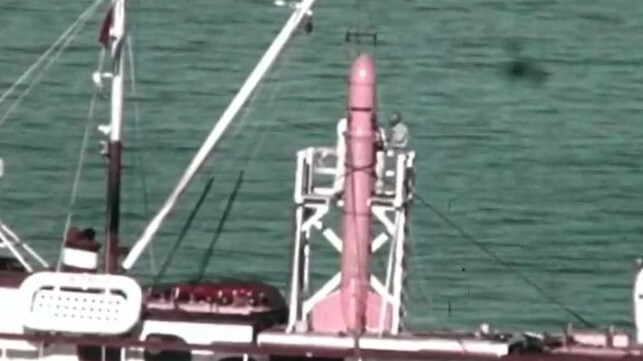
Back in the early 1960s, a team of engineers at General Dynamics' Astronautics division got permission to pursue an unusual project. With corporate funding, they designed a capsule that would sit on the bottom of the sea with a ballistic missile inside, ready to rise to the surface and launch at the drop of a sonar signal. They built and tested-launched their "Orca" launch system successfully at quarter scale (below), but the program was never implemented - at least, not in the United States. New reporting from Taggeschau suggests that Russia began designing a conceptually similar system in the 1990s, and is likely engaged in related activities today.
The original attraction of General Dynamics' Orca was its cost, and that may be its enduring appeal, according to Taggeschau. Without the expense of a manned submarine, the Orca subsea launch apparatus was affordable - about one-tenth the price of each submarine-delivered missile, when long term operating expenses were included. Orca would sacrifice some degree of a sub's survivability in conflict, but if deployed at scale, a small rate of attrition would be acceptable.
The U.S. Navy did not select Orca, and instead acquired its highly effective, highly expensive at-sea deterrent. From the late 1950s through the end of the Cold War, the Navy incurred a record-setting expense of about $125 billion (adjusted for inflation) for an inventory of ballistic missiles and 41 submarines, the "41 for Freedom" fleet. (Today, the service is repeating that investment again, spending about $125 billion for 12 Columbia-class subs to perform the same mission.)

that matters most
Get the latest maritime news delivered to your inbox daily.
The Orca concept appeared lost to history, but developments in Russia's far north suggest that it may be undergoing a revival. According to Taggeschau, NATO intelligence agencies have taken an interest in the movements of the subsea construction vessel Zvezdochka, one of a class of four special-mission ships belonging to the secretive Main Directorate for Deep Sea Research (GUGI). Zvezdochka operates out of the closed city of Severodvinsk, and few details of her construction and capabilities exist. She is believed to be fitted for handling GUGI's deep-diving submersibles and the Russian Navy's experimental subsea weapons - like the much-discussed "Poseidon" nuclear-powered torpedo. But if Taggeschau's sources are correct, Zvezdochka may also be involved with a previously-undisclosed subsea ballistic missile program, dubbed "Scythian" - a cost-efficient alternative to ballistic missile submarines.
"Positioning and maintaining intercontinental ballistic missiles on the seabed has, in my opinion, two key advantages," Helge Adrians, visiting scholar at the German Institute for International and Security Affairs (SWP), told Taggeschau. "Firstly, neutralizing them appears to be very costly. Secondly, this method offers the possibility of saving on submarines and their personnel. . . . Russia could achieve the same effect with comparatively little effort and expense for which it currently needs manned submarines."
This could be a budgetary solution for Russia. Now entering the fifth year of its invasion of Ukraine, Moscow is spending at historic levels on military recruitment and procurement. Its federal revenue stream is heavily dependent upon oil exports, and varies with oil prices and shipment volumes; early this year, the Kremlin implemented a defense budget cut - in the midst of a war - in order to keep deficit spending and inflation under control. Under the circumstances, the simple missile solution dreamed up at General Dynamics could prove attractive for a cash-constrained Russian Navy - or even a cash-constrained U.S. Navy.