
Search for Safety
War in the Middle East has offshore companies looking elsewhere.
(Article originally published in Mar/Apr 2026 edition.)
The world needs secure and reliable energy, now more than ever, and offshore E&P is one of the best ways to find it in the near term.
Energy companies have multiple options to shift future investments out of the shallow-water Arabian Gulf and into deepwater frontier regions where security risks are more manageable. Offshore oil and gas reserves are abundant along the continental margins of South America, West Africa and the Gulf of America – areas with the stability and political will to underpin development.
Now, with energy-consuming nations looking for long-term options to diversify oil and gas imports, offshore is well-placed to deliver – and profit.
KNOCKOUT PUNCH?
The ongoing conflict in the Gulf has had a substantial impact on oil production but may have longer-lasting effects on liquified natural gas.
Seaborne gas exports have to be loaded out at LNG liquefaction terminals, and the largest LNG complex in the world – Ras Laffan, the plant for Qatar's vast North Field offshore gas reservoir – was damaged by an Iranian missile strike. In one night, the attack on Ras Laffan reduced worldwide LNG export capacity by 13 million tons per annum, roughly three percent of the global total.
Repairs will take up to five years.
Luckily, the rest of the offshore industry is well-positioned to step up and add more capacity over the same period. Major gas projects make up a large and promising share of the future offshore E&P portfolio overseas, even in areas better known for oil, like the eastern continental margin of South America.
ExxonMobil's Longtail FPSO is a case in point. Located in the prolific Stabroek Block lease area off Guyana, it will be able to process 1.2 billion cubic feet of gas per day, more than any FPSO ever built. Next door, in the thriving Brazilian offshore market, Equinor is investing $9 billion to develop the massive Raia gas find in the Campos Basin. It's the Norwegian oil major's largest overseas project ever and upon completion will supply about 15 percent of Brazil's domestic natural gas needs.
FLNGs TO THE RESCUE
Shipyard-constructed FLNGs (floating liquefied natural gas facility) will go further towards filling demand for transportable, tradeable natural gas. FLNGs are massive offshore vessels designed to extract, liquefy, store and offload natural gas directly over a gas field at sea.
Rystad Energy forecasts that FLNG capacity will quadruple in ten years from 14 mtpa in 2024 to 55 mtpa in 2035. That extra boost alone will zero out the loss of two trains at Ras Laffan.
FLNGs are smaller than onshore plants and have their own technical challenges, but they've matured as a practical solution to onshore challenges. A fully offshore liquefaction-plant footprint requires no export pipeline, no mobilization for onshore construction and less physical exposure to the local security environment on land – ideal for remote projects in the developing world.
FLNGs' security advantage has proven itself in the Rovuma Basin frontier gas region, some 40 nautical miles off Mozambique. Eni was first to market in the region by a wide margin with one FLNG in production and another nearing completion.
By contrast, TotalEnergies chose to build a mega-sized LNG plant on shore in order to export its planned production from the Rovuma Basin. The plant site is exposed to the security situation in northern Mozambique, and development has been set back by five years due to an Islamist insurgency. First LNG at the TotalEnergies plant will not arrive until 2029, ten years after its launch.
Due in part to the same security-related delays, Exxon is still short of a final investment decision for a neighboring Mozambican project after years of planning.
CLOSER TO HOME
Offshore gas has a major role to play in Europe's energy security, and future supplies could come from close to home, thanks to frontier developments in the Mediterranean.
Exxon and Chevron are making big moves to explore for gas off the coast of Greece and on an expedited timeline. New offshore gas supplies can't come too soon, according to Greek Energy Minister Stavros Papastavrou. "Europe thought that dependence meant stability and that Russian gas was cheap. But one can't call something cheap if it's not safe. And Europeans learned this the hard way," Papastavrou told a panel at this year's CERAWeek conference in Houston.
As the operator of Israel's Leviathan gas field and a partner in two others nearby, Chevron is already a leader in the Mediterranean. It's also the chosen E&P partner (with Qatari backing) for offshore gas exploration off Syria – a first for the country's energy industry and a sign of the American oil major's willingness to go first in politically-challenging environments.
The area could hold trillions of cubic meters of undiscovered gas deposits, just like the rest of the Levant Basin where exploration has turned up multiple supergiant fields. Syria is in dire need of revenue for rebuilding the local economy and is motivated to bring its first offshore gas project online by the end of the decade.
"Before the summer, God willing, we will start mobilization and drilling," Syrian Petroleum Company chief Youssef Kabalawi told AP in February.
FUTURE OPPORTUNITIES
Frontier offshore regions like these could become even more attractive to oil majors in the wake of the Gulf conflict.
Brent oil futures rose by nearly 60 percent in March and settled comfortably above $100 by the end of the month. If sustained, "higher-for-longer" prices would help make the business case for offshore projects in calmer parts of the world.
But for now, the offshore drilling industry is taking it slow, says ABS' Senior Vice President of Global Offshore, Miguel Hernandez: "Clients are controlling expenses and generating revenue with existing assets right now. We see forward progress, but companies are moving cautiously. Regionally, South America and West Africa remain the big focus areas. These are important regional hubs and the future of deepwater production."
For shipowners in the business of supporting offshore drilling and production – operators of subsea, offshore supply and offshore construction vessels – the current market sentiment is favorable, says Jake Scott, founder and managing partner at shipping investment firm Easterly Clear Ocean. Large numbers of offshore vessels are bottled up in the Arabian Gulf, with positive commercial effects for owners outside the region.
"The subsea guys and a lot of these offshore folks move equipment around as they need it to meet multiyear commitments," Scott explains. "All of a sudden that equipment is no longer available. When are you going to get it? So you're seeing greater optimism in the space. You're seeing more contracting outside the Gulf as a result."
ROBOTS AT WORK
Offshore projects depend heavily on economics and cost control, and improved technology is one of the fastest ways to get there.
From planning drill paths to maintaining platforms, the offshore energy industry is at the cutting edge of adopting industrial AI and automation. E&P firms recognize the value of digital automation for speed, standardization and labor-saving, including in the "red zone" of the drill floor.
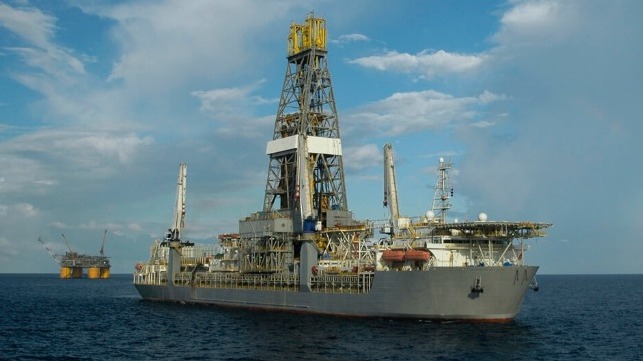
Transocean's two "eighth generation" drillships are at the forefront of the trend.
The drill rigs aboard Deepwater Atlas and Titan are highly automated, and humans rarely need to enter the working area. "We now have robots working offshore on an ultra-deepwater drillship running a riser in 10,000 feet of water without a single person being involved on the rig floor apart from the driller," said Keelan Adamson, Chief Operating Officer at Transocean, in an interview during the first ship's debut.
It's not just about safer, more cost-effective offshore drilling. Automation is also driving efficiencies on production platforms by improving predictive maintenance and speeding up troubleshooting.
VROC, an industrial AI company with experience offshore, says that an AI maintenance management system's value is in providing decision support to engineers. By analyzing data from a panoply of equipment sensors all at once – vibration, pressure, temperature, electrical loads and more – the software can provide a platform's engineering team with a set of probable options for the root cause of a problem along with a detailed explanation of which sensor values are abnormal.
This speeds up the process of identifying the right fix, cutting downtime and potentially saving tens of thousands of dollars per day in lost production. BP is an early adopter of AI-driven maintenance prediction and troubleshooting in the U.S. Gulf and claims strong early results.
CLASS APPROVAL
The top class societies are fully on board with AI offshore and are lending their expertise.
"As the world embraces more digitalization, remote operations and AI," says ABS' Hernandez, "ABS is evolving our tools and services as well. This supports our clients by giving them better predictability and knowledge of their assets, which can add days of up time and greater value."

that matters most
Get the latest maritime news delivered to your inbox daily.
Getting the implementation right is the key, says DNV, which recently carried out a comprehensive AI safety review for Norway's offshore regulator.
Training an AI model to succeed in offshore asset management requires a high-quality maintenance dataset, carefully managed to ensure completeness and relevance. With buy-in and support from engineers, the model should be kept up to date in order to counteract drift between its original training and the state of current operations, DNV advises.
The opinions expressed herein are the author's and not necessarily those of The Maritime Executive.