
France Commits to 10-Ship Naval Deployment to Secure Mideast Shipping
France has decided to dispatch a substantial naval force to the Mideast to protect merchant shipping, President Emmanuel Macron said Monday. It is the second major commitment Macron has announced towards controlling the economic impact of the U.S.-Iran conflict, following his earlier statement that the G7 would tap its strategic oil reserves.
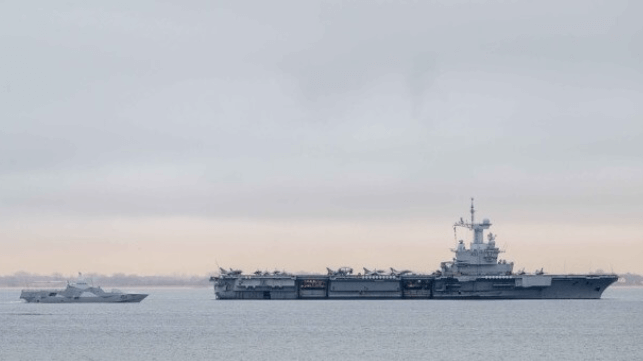
In an "unprecedented" international mobilization, France will dispatch 10 ships to key regions vital to European shipping interests: the Strait of Hormuz, the Red Sea, and the Eastern Mediterranean. The Marine Nationale already has two warships in the Eastern Med; the additional force will include eight frigates and two helicopter carriers. Taken together, it will be by far the largest French naval deployment in recent memory.
Macron is also working with European and Asian partners to contribute additional warships to the mission, which will focus exclusively on "escort and support," he said.
Macron announced the mission at a news conference in Cyprus, and later transferred to the deck of the French carrier Charles de Gaulle, the nation's flagship. The carrier has repositioned swiftly from the Baltic to the Mediterranean to prepare for contingencies and is believed to be located off Crete at present.
In comments to reporters after the speech, Macron predicted that the active phase of U.S.-Iran hostilities could persist for days or weeks.
Brief remarks made by President Donald Trump on Monday suggested that the U.S. may attempt to deescalate on a shorter timeframe, as Trump believes that the war is "very complete" and Iran has "shot everything they have to shoot." Remaining American war aims could include "taking over" the Strait of Hormuz, he said.
At a press conference later in the day, the president left wide latitude for future action or ceasefire. “We could call it a tremendous success right now, or we could go further, and we’re going to go further," he said. "We go forward more determined that we will achieve ultimate victory that will end this long-running danger once and for all." Previously, the president has called for nothing less than "unconditional surrender" to end the conflict.
On the Iranian side, the first condition for a ceasefire would be "no further aggression," Deputy Foreign Minister Kazem Gharababadi told Reuters on Monday. He added that China and Russia are in contact with current Iranian leadership about steps to reach a ceasefire deal. Kamal Kharazi, foreign policy advisor to Iran's new supreme leader, told CNN that there is not "any room for diplomacy" with Trump, and said that the war would end when other countries convince the United States to cease hostilities.

that matters most
Get the latest maritime news delivered to your inbox daily.
In Israel, which has led the way on many offensive air operations against Iranian targets, top military leadership suggested to Ynet that the conflict should continue for at least a month in order to give enough time to decimate Iran's military industrial base.
"This opportunity cannot be missed. We must not take our foot off the gas until this regime collapses - neither we nor the United States. This is an opportunity we will not have again," a senior member of the Israeli General Staff told YNet.