
Vancouver Posts Record Growth in Throughput as Canada Diversifies Trade
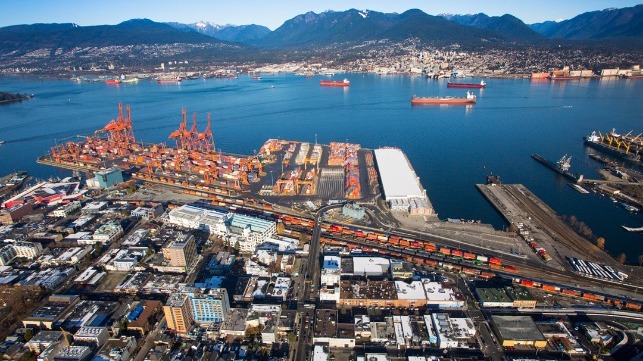
Canada’s push to increase exports to overseas markets, particularly in Asia owing to increasing protectionism by its key trading partner, the U.S, is having the desired effects. The country’s largest port, Vancouver, has seen cargo throughput hit record highs.
The Port of Vancouver is highlighting the impacts of the government’s efforts to double exports to non-U.S. markets, reporting record cargo volumes in 2025. The port handled 170.4 million metric tonnes (mmt) of cargo during the year, an eight percent increase compared to 2024. Notably, international volumes recorded an 11 percent increase to 147 mmt, including exports growth of 12 percent to 127.5 mmt.
During the year, more than three-quarters of international volumes passing through Vancouver were destined to or coming from Indo-Pacific countries. The top trading partners through the port in 2025 were China, accounting for 36 percent of the total international volumes, followed by Japan at 13 percent and South Korea at nine percent.
“As Prime Minister Carney looks to double exports to non-U.S. markets in the next decade, the Port of Vancouver is playing an outsized role in delivering more made-in-Canada products to more customers globally,” said Peter Xotta, Vancouver Fraser Port Authority President and CEO. He added that the port is uniquely poised to support Canada’s bold trade goals because of decades of strategic investments in terminal and rail capacity, developments that show the world that the country is open for business.
For Vancouver, which is making significant investments in infrastructure expansions to cement its position as Canada’s largest and North America’s most diversified port, growth was recorded in most of its business segments, with the bulk sector, which is 98 percent export driven, being the banner after posting an 11 percent growth to reach a record 130.7 mmt in 2025. Containerized cargo and auto trade also posted strong performances.
During the year, the port saw grain exports hit a new record of 30.3 mmt on the back of strong wheat exports, while potash exports surged to 10.5 mmt, breaking the previous record set in 2020. Growth was also recorded for crude oil exports, which doubled to reach 24.4 mmt. Key markets for the bulk exports were in the Indo-Pacific, Europe, Central America, and the Middle East regions.
On containerized cargo, Vancouver’s four container terminals handled 3.8 million TEUs in 2025, nine percent higher than 2024 and three percent higher than the previous record set in 2021 of 3.7 million TEUs. On the auto segment, the port handled almost 480,000 vehicles, representing a two percent increase.

that matters most
Get the latest maritime news delivered to your inbox daily.
Despite growth in most segments, the port recorded a decline in breakbulk cargo that plunged by 15 percent to 12.9 mmt, while cruise passenger visits declined by 11 percent to 1.2 million. Cruise ship visits were down by eight percent to stand at 300.
The Port of Vancouver is highlighting that as Canada prepares to double non-U.S. exports in the coming decade, the port is accelerating investments in infrastructure expansions to position itself to benefit from the expected boom. Some of the major projects include the Roberts Bank Terminal 2 for containers, which is expected to unlock $100 billion in additional annual trade capacity.