California Protects Blue Whales and Blue Skies With Historic State Law
In October, California Assembly Bill 14, “Coastal resources: Protecting Blue Whales and Blue Skies Program” (AB-14) was signed into law, making California the first state in the country to strengthen a longstanding voluntary effort to reduce air pollution and risks to endangered whale populations off California’s coast by reducing speeds of large ocean-going vessels.
Air pollution is one of the biggest environmental threats to human health, linked both to increased risk of chronic diseases and mortality. In California, due to a combination of factors, many cities and counties rank among the United States’ worst for air quality, and emissions from ships are a significant contributor.
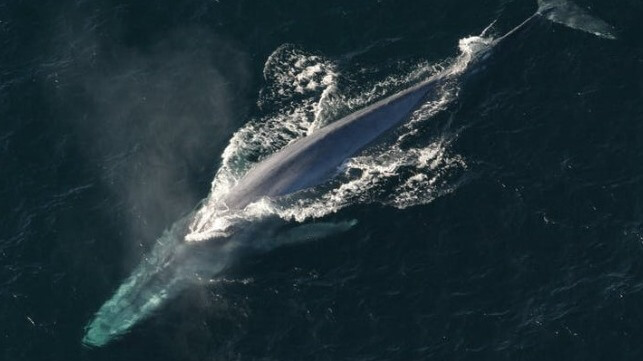
Whale-ship collisions are a top risk to endangered whales globally and California is one of the few places with protection measures in place. Now, thanks to AB 14, spearheaded by Assemblymember Gregg Hart, protections will expand as the Protecting Blue Whales and Blue Skies Program (BWBS) becomes a statewide voluntary program, with California’s Ocean Protection Council as a new partner.
Why?
California is a hotspot for both global trade and biodiversity and one of the largest economies in the world. And California’s major ports— including the Ports of Los Angeles, Long Beach, Oakland, Hueneme, and San Diego — are major hubs for international trade and major entry points to the U.S. market, accounting for about 40% of all containerized imports. Global trade and the container, bulk, vehicle carrier, and tanker ships that make it possible are critical to California and to global economies.
The goods transported by ocean freight have significantly lower carbon footprints than those moved by air. These ships, however, are also one of the top threats to whales around the world and remain a significant source of air pollution for many communities. Onshore prevailing winds push ship exhaust into California coastal communities, where cargo ships can account for 50% or more of counties’ air pollution (notably, smog-forming nitrogen oxides (NOx)). Commercial shipping is also a significant source of ocean noise pollution, which can disrupt marine animals’ capacity to communicate, navigate and forage.
However, when large vessels slow from baseline speeds of 15 knots to 10 knots or less, the risk of a fatal strike to whales is reduced by approximately 50%. Air pollution and emissions are also reduced by almost a third, and underwater radiated noise pressure is significantly lowered.
Recognizing the array of environmental benefits offered by Vessel Speed Reduction (VSR), for the past decade BWBS has verified and encouraged global shipping lines’ cooperation with voluntary, seasonal VSR requests for transit speeds at whale-safer 10 knots within set zones from May to December during peak endangered whale and smog seasons. The BWBS partners and VSR zones have consistently grown over time, from Point Conception and the Port Complex of Los Angeles and Long Beach to Dana Point to Point Arena including all 5 national marine sanctuaries off California.
From 2014 to 2024 the program resulted in:
- 1,596,008 nautical miles of whale-safer transits
- 5,900 tons of smog-forming NOx emissions avoided
- 200,000 metric tons of regional greenhouse gas emissions avoided
- 4.1-decibel reduction in participating vessels source levels
- 50% reduction in fatal ship strike risk
In 2022, to help drive awareness around and support for responsible shipping, the program opened to ambassadors — entities that import/export or work with participating shipping lines. There are now 31 ambassadors, from leading brands like Patagonia, Peak Design, Nomad, Huffy, Santa Cruz Bicycles, Deckers Brands, Toad&Co and Sonos, to the Port of Oakland and Port of Hueneme, to logistics and freight forwarding companies including JAS Worldwide, The Block Logistics and ShipCo Transport, to emissions capture and control companies like STAX Engineering.
What’s Next?
The existing program covers key transits and shipping lanes for vessels transiting up and down a large portion of coast, with Ventura, Santa Barbara County, and San Luis Obispo County Air Pollution Control Districts, Monterey Bay Air Resources District, and Bay Area Air District partnering in the effort to protect public health. However, all Californians and whales off our coast deserve the same benefits afforded by the program. The same ships and whales protected in the current VSR zones also transit and migrate off San Diego, Morro Bay and the north coast. With AB 14 signed into law, BWBS will expand geographically and expand its impact:
1. It brings an important state agency, the Ocean Protection Council, into the partnership;
2. It authorizes expansion consistent with key program elements to date — voluntary cooperation, verification and quantification of environmental benefits, and acknowledgement of industry leadership; and
3. Program expansion will not interfere with any other existing port-related VSR programs.
Next Steps:
BWBS sincerely values the insights of mariners. BWBS is working to ensure the shipping industry’s operational, safety, and other factors inform program expansion plans alongside protecting air quality and whales.
Industry members are invited to participate in a brief survey, which can be found here. As a second option, interested parties are welcome to also submit feedback here.
For more information on how to sign up your shipping line or join as a program ambassador, email info@bluewhalesblueskies.org, and sign up for our newsletter here.
BWBS partners include: California Marine Sanctuary Foundation; Channel Islands, Chumash Heritage, Monterey Bay, Greater Farallones and Cordell Bank National Marine Sanctuaries; Benioff Ocean Science Laboratory; Ventura, Santa BarbaraCounty, and San Luis Obispo County Air Pollution Control Districts; Monterey Bay Air Resources District; and the Bay Area Air District. BWBS’ success would not be possible without the strong engagement of our participating shipping lines, ambassadors and their collaborative efforts to protect whales and coastal air quality. Read more here: bluewhalesblueskies.org/impact/
This message is sponsored by BWBS.
The opinions expressed herein are the author's and not necessarily those of The Maritime Executive.